
You know the chicken breast that looks perfect going into the pan and comes out dry on one end, raw in the middle, and rubbery at the tip? That’s not bad luck, it’s due to the natural shape of the breast. Learning how to butterfly a chicken breast takes just minutes, and all you need is a knife and cutting board. It’s the one trick that instantly changes the shape and makes chicken breast taste and cook up better.

Note: This post contains referral links for products I recommend. As an Amazon Associate, I earn a small commission on qualified purchases, at no cost to you.
Quick Summary & What You Will Learn
✅ Technique: How to Butterfly a Chicken Breast + Split a Chicken Breast for Cutlets
⏲️ Time: Quick! About 5 minutes, depending on the number of breasts
🔪 What You Need: Chicken breasts, a sharp chef’s knife or boning knife, and a cutting board.
♨️ Method: Butterfly chicken using a horizontal cut and then split to make cutlets.
⭐️ Difficulty: Easy
📏 Learn How to Cut Chicken Evenly: Cut each piece of chicken the same thickness, which makes cooking easier and results in better-tasting chicken recipes.
❤️ Why You Will Love It: An easy way to adapt chicken breasts for different uses such as stuffing, breading, and grilling.
Summarize and save this content on:
What Does It Mean to Butterfly a Chicken Breast?
To butterfly a chicken breast means slicing it horizontally almost all the way through, then opening it up like a book. The resulting shape resembles a butterfly, which is where the technique gets its name.
Maybe you’ve noticed: the breasts at the store now are nearly double the size they were a decade ago. Often they’re thick as a fist on one end and thin as a pancake on the other, which means no matter how carefully you cook it, one end finishes before the other even gets close.
I started butterflying every breast that came into my kitchen years ago, and it fixed almost everything I didn’t like about cooking boneless chicken breast. One even piece, one even cook time, no more guessing which end to check with a thermometer. Once you’ve done it twice, it takes about a minute, and you’ll never go back. Use this technique to make air-fried chicken breasts and all your other favorite weeknight dinner chicken recipes.
Table of contents
Why You’re Going to Love This Technique
- Cooks evenly, end to end. This means no more dry tips or undercooked centers.
- Faster prep. A thinner, uniform piece cooks in less time.
- The perfect canvas for stuffing or filling. Makes breasts flat and even, so they’re ready to fold or roll.
- A prettier plate and presentation. Even pieces just look more put-together, especially when you’re cooking for guests
If you love learning new techniques for cooking chicken, you need to try braising chicken breasts next.
What You Will Need
- Boneless, skinless chicken breast(s)
- A very sharp knife, a 6 to 8-inch sharp chef’s knife or a boning knife, works best. A dull blade is the most common reason this cut goes wrong, so this isn’t the place to reach for whatever’s in the drawer.
- A stable cutting board, ideally with a damp towel underneath so it doesn’t slide
- Paper towels, to pat the chicken dry before cutting as a wet breast is harder to hold steady and slicker to cut
Quick Tip
If your chicken breast feels soft or slippery, 15 minutes in the freezer firms it up just enough to make the horizontal cut noticeably cleaner and easier.
Chicken Breast Half vs. a Whole Chicken Breast
A whole chicken breast, also known as a double lobe chicken breast, refers to the entire underside portion of a chicken when it is standing upright. When a recipe calls for “a chicken breast,” it typically means just one side of this portion — a single lobe, or half-breast. That’s what these instructions are for: butterflying or halving a single lobe for even cooking and easier prep.
Worth knowing: at the meat counter, “split chicken breast” usually means something different — a bone-in half breast, not the boneless piece you’re cutting here. If a recipe calls for split chicken breast, check whether it means bone-in before you start slicing.
Variations
Once you’ve got the basic cut down, it’s easy to adapt it to whatever you’re making.
- Butterflied and left hinged. Skip the final cut in half to keep a butterflied chicken breast perfect for stuffing, or for one generous portion.
- Split into two cutlets. After the horizontal cut, cut the breast all the way through, making two cutlets. Use this method when a recipe calls for breading, such as for my make-ahead chicken Parmesan recipe or this Mexican breaded chicken.
- A very large breast, cut into three. If your breast is especially thick, such as 12 oz or more, slicing it into three thinner pieces keeps the cook time even.
- Butterflied, then pounded thin. This is great for schnitzel, chicken piccata with mushrooms, or chicken Milanese, where you want the chicken thinner than a knife alone can get it.
How to Butterfly a Chicken Breast
Here are step-by-step instructions on how I butterfly and halve fresh chicken breasts. There’s a 15-second video after the written instructions and photos, if you prefer to watch.
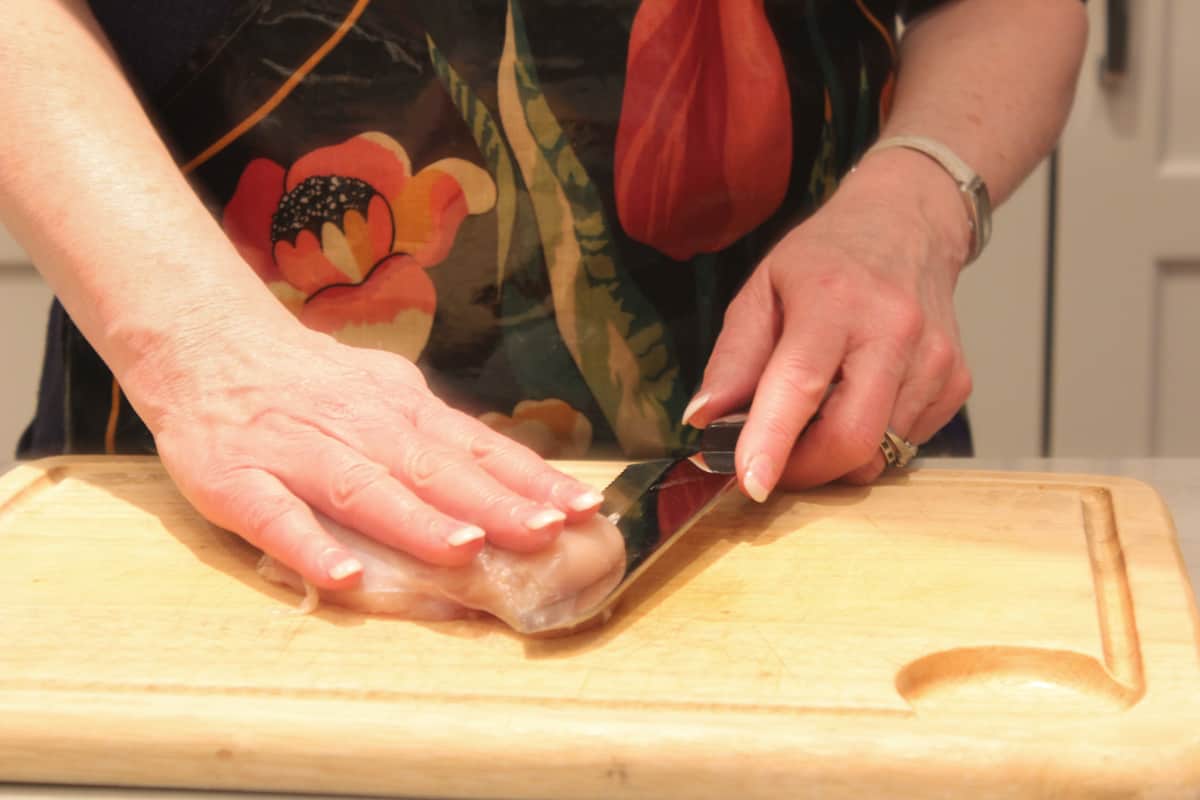
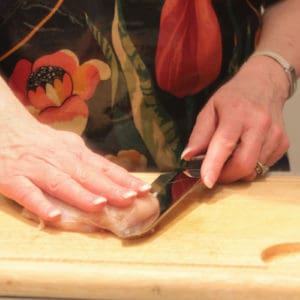
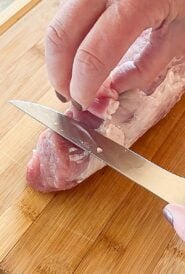
- Position chicken breast and non-cutting hand. Place one chicken breast half on a cutting board with the flat/smooth side down. Put the palm of your non-cutting hand on the top of the chicken breast, with the thick part of the breast toward the ends of your fingers and the thin end pointing toward your wrist.
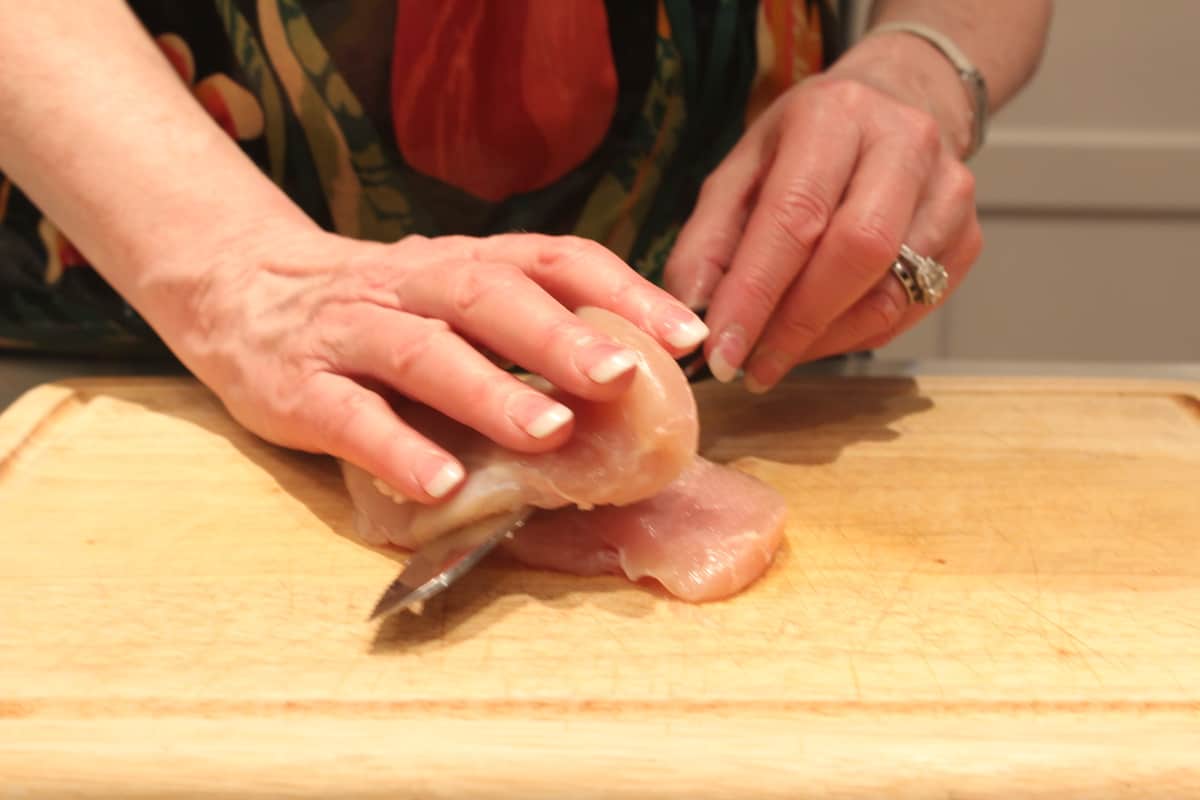
- Carefully slice the breast. Continuing to hold the breast meat with the palm of your hand, use a very sharp knife to slowly cut horizontally through the breast in a straight line, starting at the long, thicker end. Cut the entire length of the breast, from one side to the other, leaving the side of the breast opposite where you started (the thinner side) intact.
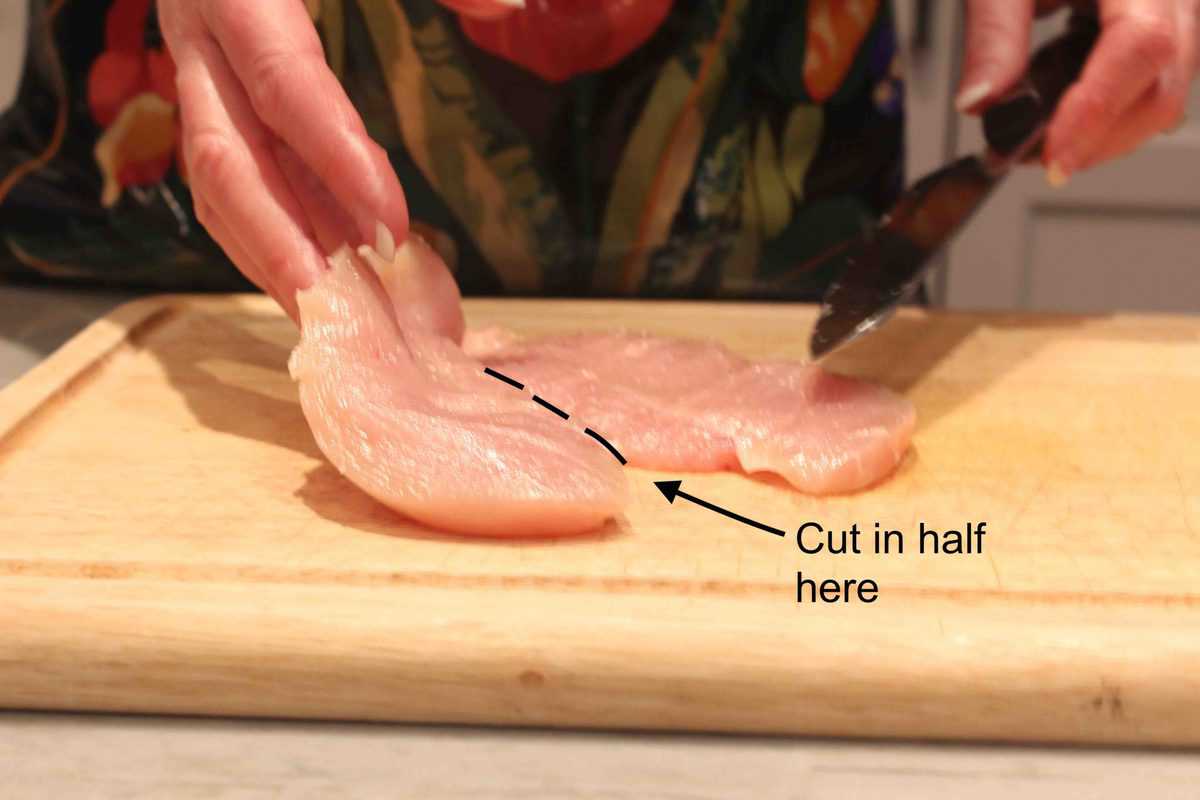
- Open breast up. Open the breast up and lay it flat. Now have a butterflied chicken breast. If you want to cut it in half to make thin chicken cutlets, cut the butterflied breast in half down the middle. Now you’re ready to use it to make chicken with olives and tomatoes for your next dinner party.
Tips for Success
- Use a sharp knife. This isn’t just about a clean cut; it’s about avoiding cuts, as a dull blade is far more likely to slip.
- Chill the breast for 15 minutes before cutting. A slightly firm breast holds its shape and slices far more cleanly than one straight from the fridge or at room temperature.
- Pat it dry first. A wet breast slides under your hand, and that’s exactly where accidents happen.
- Cutting ahead for guests? Butterfly or split your breasts the morning of, then layer them flat between sheets of parchment in the fridge. One less thing to do once people arrive.
How to Butterfly a Chicken Breast FAQs
First, whatever knife you use, it needs to be very sharp! My two favorite knives for splitting boneless chicken breasts are a boning knife and a chef’s knife. A boning knife has a long, skinny blade; a chef’s knife is anywhere from 6 to 14 inches long, and is around 1 1/2 inches wide close to the handle, and tapers to a point.
Once butterflied, a chicken breast cooks quickly and evenly since it’s no longer thick on one end and thin on the other. On the stovetop, expect about 3–4 minutes per side; on the grill or in the oven, they will take closer to 10–15 minutes total. Always confirm doneness with an instant-read thermometer to make sure the chicken is cooked to 165°F.
A whole chicken breast (also called a double lobe breast) is the entire underside portion of the bird with both sides together. A “chicken breast half” is just one side of that, a single lobe, and it’s what almost every recipe means when it simply says “chicken breast.”
Follow the same basic cut, but stop slightly further from the far edge so you have a wider hinge to fold shut once it’s filled. Season the inside, spread your filling over one half, then fold the other half back over the top. There’s no need for toothpicks because the chicken holds itself closed just fine once it’s in the pan or oven.
It depends on what you’re making. Butterflying gives you an even thickness with almost no effort and works well for most weeknight cooking and stuffing. Pounding gets the meat thinner than a knife alone can, and is worth the extra step when you’re making any recipe where paper-thin and perfectly flat really matters. For everyday cooking, butterflying alone is usually all you need.
Did you try this method?
If you followed this tutorial, I’d love to hear how it turned out. Leave a comment below, and if you make one of my recipes, leave a star rating on the recipe card, and don’t hesitate to ask questions – I’m happy to help!
More Chicken Recipes Using Butterflied Chicken Breasts

Note: This post was originally shared in 2015, then updated in 2023, and again in 2026, adding in more detail to the directions as well as more content each time.
Was this tip useful?
If you follow this tip for butterflying chicken breasts, be sure to comment and give it a rating below. And don’t hesitate to ask questions – I’m happy to help!
How to Butterfly Chicken Breasts
Equipment
- Cutting board
- paper towels
Ingredients
- 1 chicken breasts
Instructions
- Place one chicken breast half on a cutting board with the flat/smooth side down. Put the palm of your non-cutting hand on the top of the chicken breast, with the thick part of the breast toward the ends of your fingers and the thin end pointing toward your wrist.
- Continuing to hold the breast meat with the palm of your hand, use a very sharp knife to slowly cut horizontally through the breast in a straight line, starting at the long, thicker end. Cut the entire length of the breast, from one side to the other, leaving the side of the breast opposite where you started (the thinner side) intact.
- Open the breast up and lay it flat. Now have a butterflied chicken breast. If you want to cut it in half to make thin chicken cutlets, cut the butterflied breast in half down the middle.
Notes
If the hinge tears, nothing’s ruined. You’ve just made two cutlets instead of one butterflied piece. Either way, it’s ready to cook.
Repeat with as many breasts as you need. The technique doesn’t change whether you’re doing one or a dozen.
Nutrition
Nutrition information is automatically calculated, so should only be used as an approximation.




I made this last night and it was quite the hit. I love capers, my husband not so much, but even he enjoyed them in this recipe.